
Cardiopulmonary exercise testing (CPET) is the reference standard for the direct measurement of maximal oxygen uptake (VO₂ max) and the precise determination of ventilatory thresholds (VT1 and VT2) in cycling, key markers of aerobic performance.
Our incremental cycling protocol was scientifically validated against laboratory ergospirometry in a cohort of trained cyclists. The results were published in NPJ Digital Medicine, a journal within the Nature Portfolio.
This validation confirms that CHASKi can determine ventilatory thresholds with laboratory comparable accuracy.
Study Overview: CHASKi vs. Ergospirometry
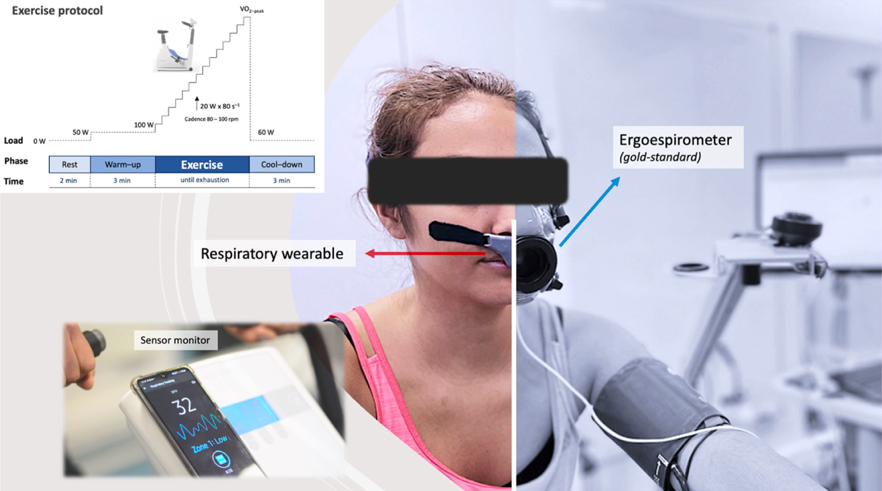
In this validation study, 17 trained cyclists (7 women and 10 men) performed a maximal incremental cycling protocol while simultaneously using the CHASKi system and a laboratory ergospirometry setup.
The objective was to evaluate the accuracy of CHASKi in measuring ventilatory variables and, specifically, in detecting VT1 and VT2 during incremental cycling exercise.
Key Findings: Accuracy in Cycling
Respiratory Rate Measurement
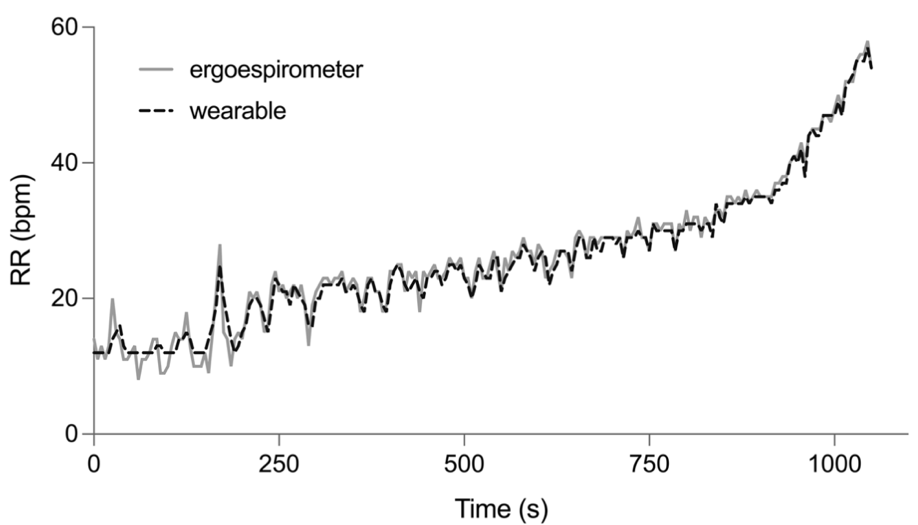
The respiratory rate (RR) error was below 1 breath per minute, a value that is practically negligible in real-world applications. Even at high exercise intensities, performance remained comparable to the reference method.
Unlike other systems that require face masks or invasive equipment, CHASKi combines validated accuracy with operational simplicity, facilitating implementation in both laboratory and field-based training environments.
Ventilatory Threshold Detection
Data analysis was conducted independently for each system: ergospirometry data were evaluated by expert physiologists, while CHASKi data were processed using the device’s proprietary protocol for VT1 and VT2 identification.
VT1 Detection: Respiratory rate correlation: r = 0.899 (p ≤ 0.001).
This represents a high correlation, supporting CHASKi’s accuracy in identifying the first ventilatory threshold.
VT2 Detection: Respiratory rate correlation: r = 0.745 (p ≤ 0.006).
For VT2, correlation was moderate-to-high and statistically significant, maintaining agreement with the reference method.
Overall, these findings confirm that respiratory rate measured with CHASKi enables accurate identification of ventilatory thresholds in cycling compared to the gold standard.
Why This Matters for Athletes and Coaches
In cycling performance assessment, accurate identification of ventilatory thresholds enables:
- Individualized training zone prescription
- Physiology-based load planning
- Monitoring of aerobic adaptations
- Objective performance control
International Scientific Validation
Publication in NPJ Digital Medicine supports:
- The methodological robustness of the study
- The statistical comparison against laboratory ergospirometry
- The scientific relevance of wearable respiratory technology in endurance performance
Within the field of exercise physiology and wearable monitoring, this validation positions CHASKi within a peer-reviewed, internationally recognized scientific framework.
Conclusion
The cycling validation demonstrates that CHASKi achieves laboratory comparable accuracy in ventilatory threshold detection.
In endurance sports, precise ventilatory threshold assessment is not a minor technical detail, it is the foundation of intelligent training prescription.
CHASKi integrates physiology, scientific validation, and real-world applicability.
Reference
Contreras-Briceño, F., Cancino, J., Espinosa-Ramírez, M., Fernández, G., Johnson, V., & Hurtado, D. E. (2024). Estimation of ventilatory thresholds during exercise using respiratory wearable sensors. NPJ Digital Medicine, 7(1), 198. https://doi.org/10.1038/s41746-024-01191-9