
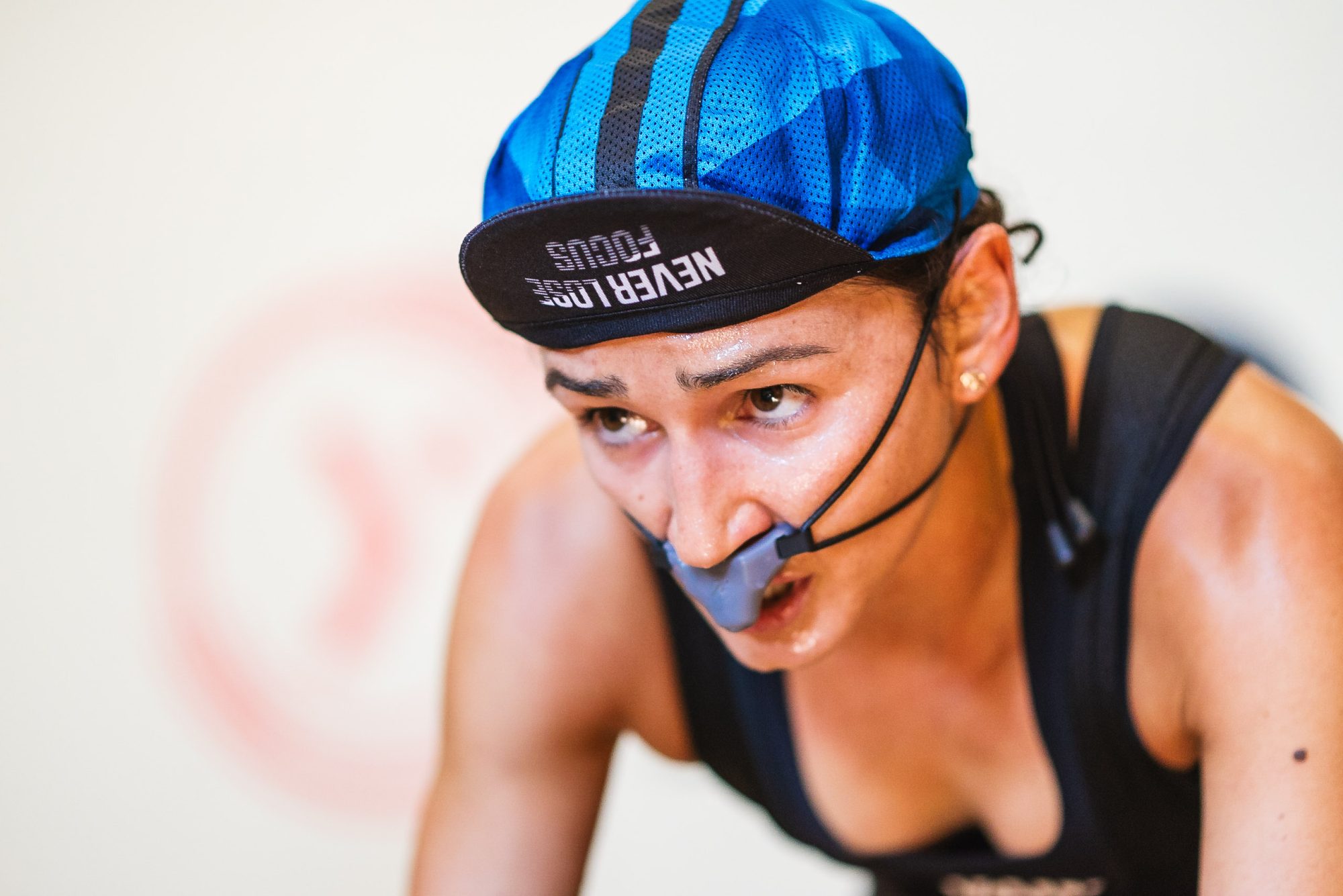
How breathing patterns shift across ventilatory thresholds and what it means for endurance training, exercise physiology, and respiratory efficiency.
Breathing is one of the most important physiological processes during exercise, yet it is rarely something athletes or coaches actively observe.
As exercise intensity increases, the way we breathe changes significantly. Understanding the transition between nasal breathing and oral breathing can help us better interpret what is happening inside the body during training.
A recent thesis conducted at Universidad Finis Terrae explored this exact question. How does the proportion of nasal and oral breathing change during aerobic exercise at different intensities? To answer this, researchers used the CHASKi device to measure breathing patterns in recreational athletes performing cycling exercise (1).
Measuring breathing during exercise
The study began with a maximal incremental test to identify each participant’s ventilatory thresholds. This step is essential because it allows researchers to determine the different physiological phases of aerobic exercise.
Once the thresholds were established, participants performed constant intensity trials within each of these physiological phases. This approach made it possible to observe how airflow was distributed between the nose and the mouth as exercise intensity increased.
At this point, an important limitation of traditional respiratory measurements becomes clear.
Most devices used to evaluate breathing during exercise cannot distinguish between nasal and oral breathing. Traditional metabolic carts rely on gas analysis masks that cover both the nose and the mouth. These systems can measure oxygen consumption, ventilation, and carbon dioxide production, but they cannot determine whether the air is entering through the nose or the mouth.
CHASKi is currently the only device on the market capable of separating nasal from oral breathing during exercise. This capability opens a new opportunity to study respiratory behavior in real training conditions rather than only in laboratory settings.
How breathing changes as exercise intensity increases
The results show a clear and consistent pattern.
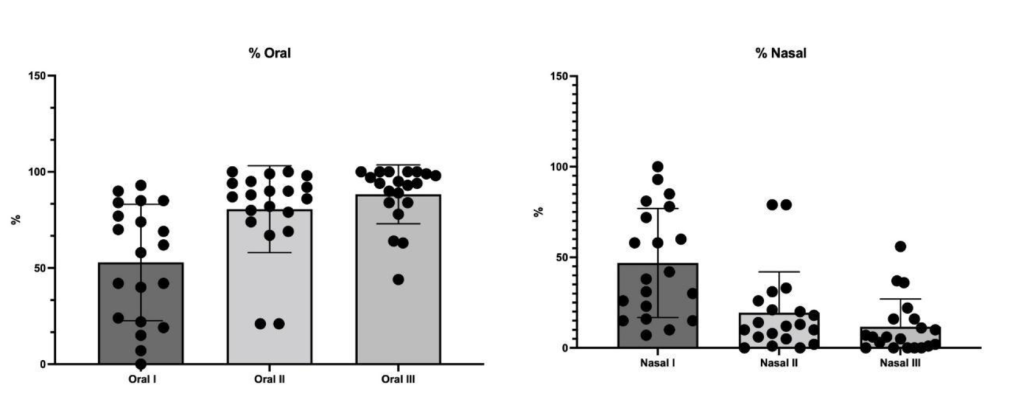
At low intensities, corresponding to the first phase of aerobic exercise, nasal breathing plays an important role and often predominates.
As intensity increases and the first ventilatory threshold is crossed, breathing gradually shifts toward a more oral pattern.
At intensities approaching the second ventilatory threshold, breathing becomes predominantly oral. At this stage the respiratory system must move much larger volumes of air in order to meet the metabolic demands of exercise.
The nasal airway creates greater resistance to airflow, which is why the mouth becomes a more efficient pathway when ventilation increases substantially (1).
Nasal breathing and exercise economy
Although oral breathing dominates at higher intensities, nasal breathing may offer important physiological advantages during low and moderate intensity exercise.
Research has shown that when exercise is performed breathing exclusively through the nose, total ventilation can be lower for the same workload. Some studies have reported reductions of around 22 percent in ventilation along with a decrease in oxygen consumption during submaximal exercise (2).
This suggests that nasal breathing could contribute to greater physiological economy at certain training intensities, since ventilation itself requires muscular work.
For endurance coaches and athletes, this opens an interesting possibility. Nasal breathing may serve as a simple tool to regulate intensity during easy aerobic sessions.
What we can learn from this
Understanding how breathing changes during exercise helps us better interpret what is happening inside the body when we train.
At low and moderate intensities, nasal breathing may play a role in regulating effort and supporting physiological efficiency. At higher intensities, the transition toward oral breathing is simply a normal response that allows the body to move more air.
Thanks to new respiratory monitoring tools, it is now possible to observe these changes in much greater detail. This opens a new dimension for coaches and athletes who work with training zones. Understanding when breathing naturally shifts from nasal to oral can become another useful signal for identifying changes in physiological intensity. If this transition occurs too early, it could indicate lower ventilatory efficiency. After all, something as simple as the way we breathe can reveal a great deal about how the body is responding to effort. Have you ever noticed at what point in your training this shift happens?
Sources
[1] Retamal González, J., & Tobar Gamboa, S. (2024). Proporción de la ventilación oral nasal a diferentes intensidades del ejercicio aeróbico en deportistas recreacionales de la Universidad Finis Terrae (Undergraduate thesis). Universidad Finis Terrae, Santiago, Chile.[2] Dallam, G. M., Kies, B., Foust, C. P., & McClaran, S. R. (2018). Effect of nasal versus oral breathing on VO₂max and physiological economy in recreational runners following an extended period spent using nasally restricted breathing. International Journal of Kinesiology and Sports Science, 6(2), 22 to 29. https://doi.org/10.7575/aiac.ijkss.v.6n.2p.22